

How Will We Fund the Public Transport Revolution? – Public Transportation Levy
Better Buses for Strathclyde spend a lot of time talking about re-regulation of the bus networks and setting up a publicly-owned bus company and laying out the benefits that this will have for the people of Strathclyde. Namely flat fares, increased frequency, integrated ticketing, standardised services, unified branding and more.
Naturally, a lot of questions about funding arise from various directions, supporters and detractors alike, due to the idea that this is quite a radical departure from what we currently have and radical departures are expensive. Of course, immediate thoughts go to increased fares or increased personal taxes like income tax or council tax, surely if it was as easy as signing a contract then we would have it now, there must be a catch and that catch must hit our wallets.
Well, not necessarily, or at least not in the unimaginative ways our minds are drawn. All across the world are various tax structures and revenue-raising powers that we could choose to implement to fund our public transport revolution and I’m going to spend a few articles looking at some of those examples and how they may be applied here in Strathclyde.
Over the course of these articles, I think it will become clear that actually this change is not quite as radical as some would have us believe nor as expensive.
Versement Mobilité/Public Transportation Levy
This one goes by a few different names: versement mobilité in France, public transportation levy in Vienna, or simply payroll tax in the USA. This is a tax levied on employers in the region which is paid directly to the regional transport authority.
In France, this covers employers, regardless of the sector they operate in, who employ more than 11 people and the rate they pay depends on where their business resides. In Vienna, it is paid by all employers at a flat cost per employee and in the USA, it is a flat percentage rate.
What are the Benefits?
A public transportation levy provides a stable source of income to the local transport authority to allow them to plan long term investment in the network, rolling stock and staff. It means the local transport authority does not need to go cap in hand to the government asking them to reinstate certain funding streams or delay, downgrade or cancel projects due to lack of funds.
The money is paid directly to the local transport authority and so is ring-fenced for transport spending keeping fares down, expanding the network, raising standards for employees and improving the vital infrastructure. It could also free up council funding for other sectors in dire need of investment such as housing and sanitation.
How is it Implemented Elsewhere?
In France, the power is devolved to local authorities to set the exact rates and is dependent on the population of the area, currently those rates are 0.55% of salaries in areas with 10,000 – 100,000 inhabitants or 1% in areas with greater than 100,000 inhabitants. It can also be used to raise revenue for capital projects and the rate can be increased to 0.85% in areas with 50,000 – 100,000 or 1.75% in areas with greater than 100,000 people where the local authority has decided to build dedicated public transport infrastructure.
Urban communities can increase the maximum value by 0.05% and those deemed tourist communes can increase by a further 0.2% so urban, tourist centres such as Lyon can charge 2% transportation tax. The Île-de-France region has special dispensation to charge up to 2.95% as the top rate for this tax.

This is a payroll tax paid by employers and so if a company employs 20 people and pays them a combined total of £1m then they could pay between £5.5k – £29.5k in transport tax depending on where they are based. This breeds an implicit understanding that where a company chooses to base itself has an impact on the locality and its workers and employers cannot outsource transport costs to the individual employee.
In further acknowledgement of that last point, employers in the private sector are legally required to reimburse staff public transport costs by at least 50%. They may also choose to do the same for personal transport (i.e. private car) but it is not a legal requirement.
This is a huge boon for French public transport, in 2023 the regional transport authority for Île-de-France (where 9.4 million passenger journeys are made per day) reported that the versement mobilité and transport reimbursement costs accounted for 48% of its annual revenue, or over €5bn. In Lyon, versement mobilité accounts for nearly 50% of the regional transport authority’s revenue, over half a billion euros, meaning the annual revenue for the transport authority in Lyon is over €1 billion!
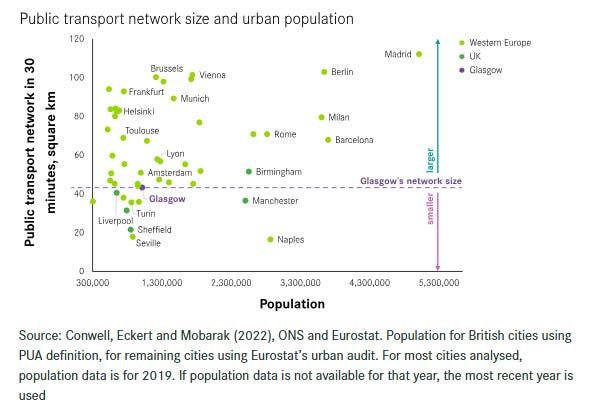
As shown below, taken from the Centre for Cities report on Glasgow’s public transport network, Lyon only has a slightly larger population than Glasgow but is much more well connected.
In Vienna, the public transportation levy is a flat rate of €2 per employee per week and raises around €70m per year. Information on this specific levy is sparse but based on the rough figures it only applies to around 673,000 people which is about 63% of the total number of employed people in Vienna so there must be some exemptions.
In the United States, the city of Portland, Oregon, is much more progressive with their transport systems than we are in the UK and operates similar to the European standard model. They have a municipal transport authority, TriMet, with revenue-raising powers through taxes and the ability to issue bonds. They have a fairly extensive public transport system with tram-like light rail and flat fares.
They implement a transit payroll tax on all employers who pay wages in the TriMet area. This is currently set at 0.8237% and is by far the largest revenue source for the transit agency raising around 66% of its operating budget.
In New York, the rate varies depending on location and is banded by payroll expense so companies with higher total salaries pay higher taxes. In Zone 1, which are the five boroughs of New York, the rates don’t kick in until a total payroll of $312,500 at a rate of 0.055% and rises to 0.895% for total payroll of $2.5m and above. In Zone 2, the rates are lower but still banded by total payroll.

What Could This Mean for the Strathclyde Region?
There are clearly a few different ways that a payroll tax could be implemented to try and minimise the impact on small businesses while maximising the revenue for public transport and balancing the revenue lost through increased admin. A taxation scheme like a public transportation levy is flexible enough that it can be tweaked to suit the location that it is being implemented, for example it may only be necessary to apply it to businesses operating in Glasgow city centre or the Glasgow City Region rather than the whole of the Strathclyde region.
Exactly how this would be implemented in Strathclyde would need some careful consideration but below are some worked examples to show the huge potential that this could have for Strathclyde. I used the most recent Labour market profile for employment statistics and the ONS for median salaries per SOC level.
A few different scenarios:
· A flat percentage rate across all employers regardless of area or total payroll
· A flat percentage rate across all employers banded by area regardless of total payroll
· A percentage rate across all employers banded by total payroll regardless of area
· A percentage rate across all employers banded by area and total payroll
The French example, where flat rates are set by area, would likely be the most flexible and have the highest rewards. For simplicity, I have left out Argyll and Bute and assumed all employees are full-time earning the median salary for Scotland (£38,480).
So first off, a flat payroll tax rate of 1% across all employers throughout the region would raise £310 million annually. This would probably be the most unfair way to introduce the tax as small, local businesses would be required to pay it at the same rate as the large multinational banks based in Glasgow City, though obviously their total payroll will be much lower.
In France, the rates change depending on the area that the business is located, in the table below I’ve offered a couple of scenarios where the rates would change by council area.
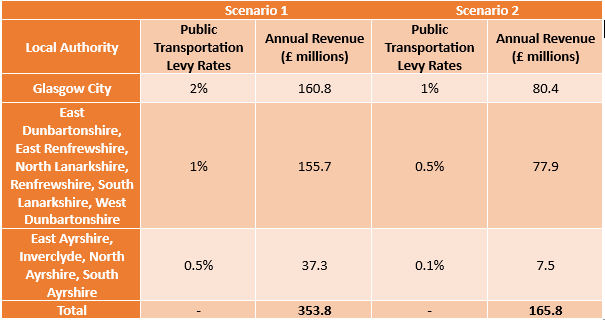
This would be astronomical and absolutely transformative for SPT, scenario 1 raising £353.8m would amount to roughly 10 times the current local authority funding for SPT from all 12 councils. Even if this was only levied in Glasgow City it is clear to see the huge revenue-generating potential that this tax can have. In an ideal scenario, the local council would decide on the transportation tax rate but would need to meet a minimum threshold payment to SPT.
Even copying the Viennese model where flat rate is levied per employee, say £100 per year, would generate £81 million and if similar levels of exemptions are applied it would generate around £51 million, a significant boost in funding.
Using the median salary probably underestimates the total payroll because we have a minimum wage. In the UK, the minimum wage for over 21s is about £23,000 but there is, theoretically, no maximum salary and some individuals at large corporations will be on upwards of £200,000. However, assuming all employees are full-time will overestimate the total payroll as it doesn’t account for part-time employees with reduced wages.
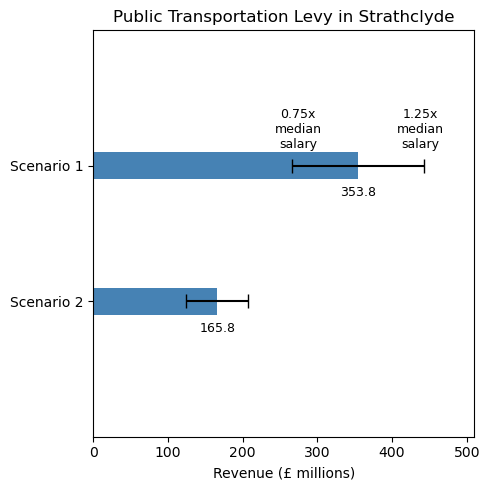
To try and strike a balance I have also added some error bars where I have used 75% median salary and 125% median salary to provide a range of possible revenue generated by implementing this tax, taking into account the limitations of the estimation. For scenario 1, this is between £265 – £442 million and for scenario 2 it is £124 – £207 million, a serious injection of cash even if the estimate is inaccurate.
As previously explained, in New York this tax is banded by area and further banded by total payroll where organisations with smaller payrolls will be charged less but it will be tied to total salaries rather than number of employees, so a small high-salary organisation will pay more than a larger modest-salary organisation. To try to estimate this I have used the Standard Occupational Classification (SOC) major groups as a rough guide for total payroll. As you’d expect people in major groups 1 – 3 would be more likely to work for an employer with a higher payroll.
Leveraging all of the possible permutations is probably quite a key way that the tax could be used to generate a lot of revenue while minimising unintended negative impacts, however, there will be a much higher administrative burden.
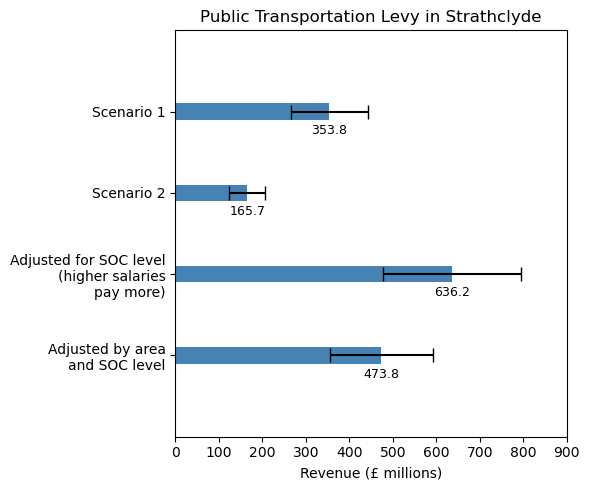
In the scenario where employers pay a higher rate of payroll tax on employees in higher SOC bands (which have higher median salaries) this could raise nearly £800 million annually assuming 1.25x median salary for all employees in the region. If this is adjusted by area and the rate lowered for areas outside Glasgow city it is still around £600 million!
Some limitations of the method:
· The data used is for earnings of residents in the council areas, some may reside there but work in another council area as will likely be the case for the councils surrounding Glasgow city.
· It does not take into account exemptions for businesses which may not meet an employee threshold (e.g. 11 employees) required to pay the tax.
· Use of median salary may not reflect the true earnings across the region as some employed at the large multinationals based in Glasgow City may earn 5 times (or more) the median and so this may underreport the possible revenue.
· Using SOC level to band total payroll works it more into an income tax (paid by employers in this case) than a payroll tax.
So this levy could have massive benefits for public transport in Strathclyde by allowing SPT to invest in the public transport network and infrastructure. Depending on the way it is implemented, and there can be a large amount of local government control in the exact rates, it could potentially raise between £50 million and £800 million a year using rough salary estimates. Ka-ching.
This could allow a comprehensive redesign of the bus networks, a new and numerous zero-emission bus fleet, bus priority infrastructure throughout the region, lower fares, an expanded subway, an ambitious Clyde Metro. Maybe SPT could administer the road maintenance and take the strain from the councils. The possibilities are endless…